How Francis’s first martyrs gave the Church Saint Anthony of Padua
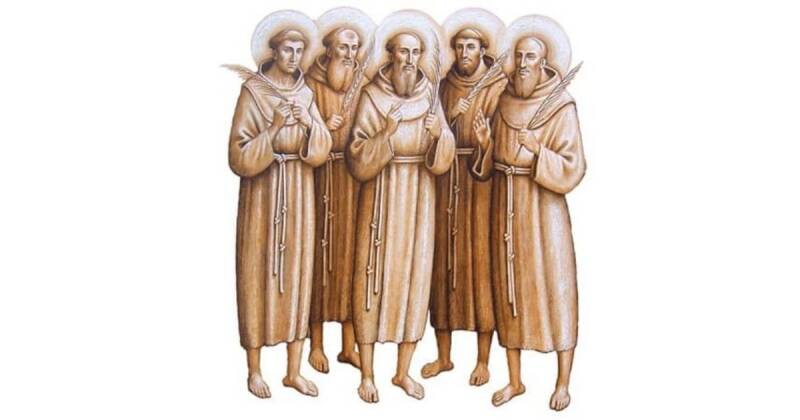
On January 16, the Church remembers the First Franciscan Martyrs - Saint Berard of Carbio and his companions Peter, Odo, Accursius, and Adjutus.
Their witness continues to speak today, especially in this Holy Year of Francis, and it helped form one of the Church’s most beloved saints.
Ordinary Brothers
It is important to understand who these men were. They were not famous preachers, or powerful figures or even trained missionaries.
They were ordinary friars, priests and lay brothers, who heard Francis of Assisi preach the Gospel and decided to do the same.
Berard of Carbio, the leader of the group, came from a noble family in Umbria, not far from Assisi. He joined the Franciscan movement very early, in 1213, and was received into the Order by Francis himself. Berard was well-educated, spoke Arabic, and was known as a gifted preacher, learned, yet deeply humble.
His companions reflected the diversity of the early Franciscan family. Peter and Otho were priests while Accursius and Adjutus were lay brothers. Together, they embodied Francis’s vision of fraternity: clergy and laity, educated and simple, united as lesser brothers.
They owned nothing. They lived simply. They travelled on foot. They begged for their food. And they believed the Gospel was worth everything.
And when Francis sent them to Morocco in 1219, they went, not with weapons, not with protection, but with faith.
Why Morocco?
In 1219, at the Second General Chapter of the Franciscan Order, Francis made a bold decision. The friars had spread quickly across Italy and parts of Europe, but Francis sensed that the Gospel could not stop there. He believed the time had come for his brothers to go beyond Christian lands.
Francis himself set out east toward Egypt and Syria, where he would famously cross battle lines to meet the Sultan unarmed. At the same time, he entrusted Berard and his companions with the mission to Morocco, one of the most dangerous destinations imaginable for Christian preachers.
They were not sent as conquerors or debaters. Francis was explicit: his brothers were to go humbly, live peacefully among others, own nothing, trust God for everything, and speak about Christ only when the moment allowed. Francis himself believed that the Gospel was for everyone, even those who did not want to hear it. He once told his brothers that when they went among non-Christians, they should first live humbly and peacefully, and only preach when the moment was right.
That was the risk these brothers accepted.
The First to Pay the Price
In Morocco, their preaching was considered dangerous and offensive. They were imprisoned, beaten, and repeatedly told to leave or renounce their faith.
They refused. And on January 16, 1220, they were executed.
Their blood became, in the words of later Franciscans, “the first fruits of the blood of the Friars Minor.”
When Francis heard the news, he did not despair. Instead, he is said to have exclaimed:
“Now I can truly say that I have brothers.”
In other words, they had followed Christ and Francis all the way.
The Saint They Inspired
The story does not end in Morocco.
The bodies of the martyrs were brought back to Coimbra, Portugal, and exposed in the Church of Santa Croce. There, a 25-year-old Augustinian canon named Fernando saw their bodies. The Holy Spirit stirred his soul at the sight of those five friars; five ordinary men who had given everything for Christ following the rule of Francis. Fernando felt a burning desire to follow the same path. It was a decisive turning point for the young Fernando to advance on the path of Christian perfection. Fernando was inflamed with the desire of martyrdom, and resolved to become a Friar Minor, that he too might preach the Faith to the Saracens and suffer for Christ's sake.
Quietly, almost in secret, he left the Augustinians, joined the Franciscans, and took a new name: Anthony.
That young man would later be known to the world as Saint Anthony of Padua.
In 1221, Anthony set out for Morocco, hoping to follow in the footsteps of the martyrs whose witness had changed his life. He longed to give himself completely for Christ, even to the point of suffering. But the Lord had other plans.
Struck by serious illness, Anthony was forced to abandon his journey. As the ship attempted to return, a violent storm drove it off course and it was forced to land in Sicily. There, Anthony remained for some time, recovering his strength.
When he was well enough to travel again, he heard of the Chapter of Mats; the great gathering of Franciscan brothers that Saint Francis of Assisi had called in Assisi. Anthony travelled there and took part in the meeting, still largely unknown to Francis and the wider fraternity. It was after this that Anthony was sent to the province of Forli where by chance he was commanded to preach for an ordination. Anthony began timidly, but soon amazed all present with his profound insight into Holy Scripture. The fire that had once drawn him toward martyrdom was now being shaped into a different kind of offering, through preaching and teaching.
The martyrs were the first blood shed of the Friars Minor, and from their sacrifice came its first visible fruit: Anthony’s conversion to Franciscan life, and through him, drawing multitudes to repentance and faith.
The first Franciscan martyrs did not only die for Christ.
They gave the Church a saint.
Francis’s Legacy Is Not Sentimental
In Assisi today, we often encounter a gentle, peaceful image of Francis with birds, flowers, sunshine, amid the majestic Umbrian landscape. That image is true, but incomplete.
Francis was also radical. He took the Gospel seriously. He expected it to cost something. One saying often attributed to him captures this spirit well:
“Preach the Gospel at all times. When necessary, use words.”
Whether or not Francis spoke these exact words, he lived them. And so did Berard and his companions.
Their lives preached. Their poverty preached. Their courage preached. Even their deaths preached.
What Does It Mean to Follow Francis Today?
As we stand at the beginning of a new year and within the Year of Francis, this story leaves us with a simple but demanding question. Not whether we admire Francis, the martyrs, or Saint Anthony but whether we are willing to let the Gospel shape our lives with the same seriousness. Their paths were all different: Francis through radical poverty, the martyrs through fidelity unto death, Anthony through preaching that set hearts on fire. Yet all three followed the same way; a life wholly given to Christ.
Perhaps our call today is not to do something extraordinary, but to make a firm and quiet intention: to live more faithfully, more simply, and more courageously.
Saint Berard and Companions, first martyrs of the Franciscan Order - Pray for us.
Saint Anthony of Padua - Pray for us
Saint Francis of Assisi - Pray for us
Add comment
Comments